GUIDES
Black Sea FFA Openings: Choose Land, Coast, and a Second Exit
Choose a Black Sea public FFA spawn by playable land pocket, contested exit, usable coast, and a second route before the opening closes around you.
Direct answer: secure one land exit, keep the coast, and prove a second route
On Black Sea public FFA, do not spawn for a country name or the shortest visible coast. Choose a playable land pocket with one defendable expansion lane, reachable Black Sea shore, and an independent second route. Secure the land exit before investing in boats; treat the coast as an option, not an obligation. If two humans contest the same pocket or terrain closes your backup, move during the spawn timer instead of repairing the position later.
Black Sea punishes the most familiar spawn shortcut: clicking a quiet-looking edge and assuming that the surrounding green land forms one continuous continent. The central sea is obvious, but the rivers, narrow water cuts, and impassable mountain bands divide the playable land into many separate pockets. Two points can look close on the thumbnail while requiring a Transport route, and two points on the same outer edge can have completely different access to the central sea. Your first question is therefore not “Which country is strongest?” It is “Which exact land component am I buying, who else can enter it, and where is my independent way out?” The nation labels are orientation marks, not player spawn rankings, and a country with a coastal marker does not guarantee that your chosen tile has the same route.
Use SHORE during the countdown: Scan the actual playable pocket, Hold one bounded land exit, Open a usable coast, Reserve a second route, and Exit the plan when either route stops paying. This is an editorial memory aid, not a hidden game mechanic. It forces you to distinguish a real opening from a pretty location. A real opening lets you expand without immediately creating three human borders, reach ocean water without stripping the home reserve, and redirect if the first target is claimed. A pretty location may offer a long coast or a corner, yet still trap you behind a Nation, a mountain wall, or another human who owns the only passable corridor.
The order matters. Land first does not mean “ignore the sea”; it means that a Port or Transport must solve a named problem rather than compensate for a failed spawn. If your pocket has neutral land and one manageable rival, take the bounded land route while preserving coastal access. If your pocket is already crowded, the coast can become the independent second route, but only after you identify a reachable opposite shore and keep enough troops at home. If your coastal path and land path both run through the same threatened tile, they are not two routes. Move your spawn or choose a different branch. The rest of this guide turns SHORE into a board-reading routine, compares four spawn families, and tests it against two concrete public-FFA situations.
Version boundary and the terrain facts that matter
This guide is current for v0.34.20, the latest formal non-TEST release on 2026-09-29. That release does not announce a Black Sea-specific rule change, so the stable map files are the authority for the opening geometry. The v0.34.20 manifest defines a 1,500 by 1,100 source map with 1,165,868 land tiles, a 750 by 550 map4x gameplay asset with 285,772 land tiles, nine default Nations, and multiplayer rotation weight 6. General combat, economy, or lobby modifiers can still vary by match; the facts below describe the map, not a guaranteed public-lobby population or outcome.
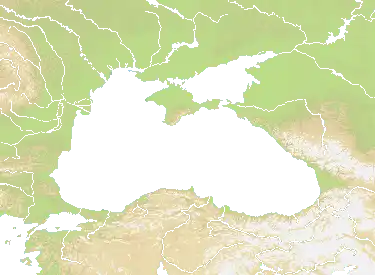
Official OpenFront Black Sea thumbnail. Use it to orient north, south, east, and west, then zoom into the live spawn screen before committing.
| Current map fact | v0.34.20 value | Opening consequence |
|---|---|---|
| Full terrain canvas | 1,500 × 1,100 | A coast that looks close on the thumbnail can still be a long land march |
| Manifest land tiles | 1,165,868 | There is ample land, but it is not one continuous playable mass |
map4x gameplay grid | 750 × 550 / 285,772 land tiles | This is the fixed scale used for the component comparison below |
Passable map4x land components | 26 | Rivers and water can make nearby-looking starts independent or boat-gated |
| Largest component | 140,632 tiles / 49.2% of passable land | The southern-eastern arc has more rerouting room than the northern and western pockets |
| Default Nations | 9 | Nation markers help orientation, but live human placement determines pressure |
| Multiplayer rotation weight | 6 | Black Sea is an ordinary recurring multiplayer map, not a one-off special layout |
The component count uses four-direction adjacency on map4x and excludes land encoded as impassable. It is useful because player movement and ownership cannot cross a water or impassable band merely because both sides are visually land-colored. The largest component contains the current Turkiye, Russia, Georgia, Armenia, and Circassia Nation anchors. Bulgaria, Romania, Moldova, and Ukraine each sit on other measured components. That does not mean every player near those labels inherits a sealed national zone; spawn tiles are chosen on the live board, and small bridges or water routes still matter. It means you must test the route instead of assuming a continuous walk around the sea.
Distance to water also varies. At map4x scale, the Romania Nation anchor is four passable pixels from water, Moldova nine, Georgia thirty-seven, and Turkiye forty-nine. These are orientation measurements from fixed Nation coordinates, not UI distance units or recommended player spawn distances. Their value is comparative: an interior southern start can require a deliberate corridor before a Port becomes practical, while a northwest start may reach water immediately but face a much smaller land pocket. The map therefore creates a real tradeoff between quick water access and land flexibility rather than a single best coast.
The SHORE decision framework during the spawn timer
Start with Scan. Zoom far enough to see water and mountains, then close enough to see whether the tile you want actually belongs to the same passable pocket as the neutral land you plan to take. Count human spawn rings that can reach the pocket without crossing ocean water. Count Nations only after humans, because a Nation is predictable pressure while a nearby human can full-send, negotiate, or reroute. Mark one desired land direction, one reachable coast, and one fallback. If you cannot point to all three on the live board, you do not yet have a plan; you have a coordinate.
Next, Hold one bounded land exit. “Bounded” means the push has a visible finish: a Nation, a narrow corridor, an outer map edge, or a short front that can be stopped before it opens two more borders. It does not mean attack the nearest object. Your opening land route should improve the shape of your territory, reduce the number of exposed approaches, or connect you to a better coast. If the route ends in another human who has the same amount of free land behind them, the battle is likely to spend both players for a third party. Choose a parallel neutral route or move the spawn while the timer still allows it.
Then, Open a usable coast. A usable coast is ocean-connected, has enough owned shoreline for a Port without exposing the entire economy, and points toward a destination that changes your position. The Black Sea itself is the central rerouting system, but owning shoreline is not the same as being ready to cross. Before building for water, name the opposite shore, the reason to go there, and the home reserve you will not spend. If the answer is merely “there is water,” defer the investment. The transport landing guide covers execution after you have selected a viable coast; SHORE decides whether water is actually your second lane.
Reserve means preserve an independent route before the main route becomes urgent. A reserve route may be an unclaimed land corridor, a second coastline on the same pocket, or an opposite-shore landing that does not reuse the threatened border. Independence is the test. If both routes depend on defeating the same neighbor, crossing the same narrow tile, or keeping the same exposed Port alive, one counter closes both. A reserve route can remain unused for several minutes; its value is that it prevents the map from dictating one desperate fight after your first branch fails.
Finally, Exit the plan when its evidence changes. Stop a land branch when a second human arrives, the target receives a stronger ally, or the capture would open more fronts than it closes. Stop a coastal branch when the opposite shore is occupied, your home reserve falls below the amount needed to survive a counterattack, or the Port would be built only to justify a boat you already wanted. Exiting is not surrender. It is the decision that turns Black Sea geometry into flexibility: you leave a branch while the reserved route is still usable, rather than after every troop and building is committed to a corridor that no longer pays.
Four spawn families: northwest pockets, western gates, southern depth, and the eastern arc
The northwest pockets, around the visual Romania-Moldova-Ukraine side of the map, offer the easiest-to-see Black Sea access and some of the most misleading land assumptions. The tagged Nation anchors there sit on distinct measured map4x components: Romania on 8,636 tiles, Moldova on 10,530, and Ukraine on 17,938. A live player can spawn elsewhere within or near those shapes, so do not turn the numbers into country rankings. Use them as a warning that “north coast” is not one shared highway. The good northwest start has one human competitor, a short neutral route, and ocean access that is not the same tile as the contested border. The bad one has two players squeezed into the same pocket, no independent inland exit, and a coast that only points toward another occupied shore.
The western gates, visually around Bulgaria and the Bosphorus side, trade broad depth for chokepoints. Bulgaria’s anchor lies on an 18,554-tile measured map4x component. The map image also shows water cuts and narrow approaches around the southwest corner. A bounded gate is valuable when it reduces the number of directions that can attack you, but a gate becomes a prison when another human owns the only passable exit. Before selecting a western corner, trace the route one screen farther than the first neutral target. If it terminates at water or impassable terrain, your coast must already be viable as the second route. If the coast is also controlled, the “safe corner” has no recovery branch.
The southern depth, visually around Turkiye, belongs to the map’s largest measured passable component: 140,632 map4x tiles, or 49.2% of all passable land. Its official Nation anchor is forty-nine passable map4x pixels from water, so southern does not automatically mean coastal. The advantage is room: the same large component continues toward several eastern anchors, allowing land reroutes that smaller northwest pockets cannot offer. The cost is contact: more continuous land can produce more eventual human borders. A good southern spawn therefore sits off the obvious central traffic line, owns one route toward the sea, and keeps another path along the landmass. A bad southern spawn is placed in the middle because “there is lots of land,” then discovers that every player on the large component can eventually turn that room into another approach.
The eastern arc, from Russia through Circassia, Georgia, and Armenia, contains the strongest contrast between nearby coast and deep interior. All four anchors share the same 140,632-tile component, yet a fifty-pixel sample around Circassia is only 59.3% passable land while the Russia, Georgia, and Armenia samples exceed 96%. That spread makes labels especially dangerous. A spawn toward the northeastern shore may support an early Port option; a southeastern interior spawn may need to win a land corridor before water matters. The eastern arc’s advantage is that a failed first land target can often be replaced by a different route on the same component. Its danger is pretending that this route diversity equals safety while three humans are growing on different sides.
Choose among the families by live pressure, not by a permanent tier list. Northwest is attractive when the pocket is underfilled and the coast is unclaimed. West is attractive when you own the gate rather than face it. South is attractive when its depth gives two genuinely separate lanes. East is attractive when you can convert component size into route choice before multiple borders mature. If two families look equal, prefer the one where the second route does not require an immediate building or war. That preference buys time, and time is what lets you see whether the lobby is distributing players evenly or turning one attractive coast into a crowded trap.
Scenario one: a crowded northwest coast with one apparent exit
Assume a public FFA where your spawn ring is on the northwest side near the Romania visual marker. The official marker is four passable map4x pixels from water and belongs to an 8,636-tile measured component, but your exact tile is not the marker. During the countdown you see two other human rings that can reach the same pocket, one Nation between your preferred tile and the interior, and an open coast behind you. Across the water is unclaimed land, but the landing would expose your home if launched immediately. The tempting plan is to choose the prettiest coastal tile, build toward water, and race both neighbors with a Transport.
Run SHORE instead. Scan confirms three humans are contesting one finite pocket; that is the decisive fact, not the eight-step marker measurement. Hold asks for a bounded exit. One neighboring human sits beside the interior Nation, while the other is farther along the coast. Choose a spawn where the Nation or a narrow land neck separates you from one player and where your first neutral expansion does not point directly through the other. If no such tile exists, move to a different pocket during the timer. A crowded component with no bounded land route fails before the match begins.
Suppose you stay and use an illustrative opening budget of 100 parts: keep 60 at home, spend at most 25 on the first bounded expansion, and leave 15 uncommitted while you watch which neighbor turns toward you. These are coaching proportions, not fixed game thresholds. The purpose is to prevent the coast from consuming the reserve that makes the land gate credible. Open the coast by owning enough shoreline to preserve a future Port location, not by buying the Port immediately. Watch the opposite shore and the central water lane. If another player claims the landing area, the water branch is losing value before you have spent on it.
Reserve an exit that is genuinely independent. In this position, the reserve is either the coast toward a still-open opposite shore or a land strip that bypasses the interior rival. It is not an attack through the same rival from a different angle. Your first positive signal is one neighbor committing heavily away from you; that creates a bounded land capture or gives you time to prepare water. Your first negative signal is both neighbors expanding toward the same neck. At that point Exit means abandon the Port plan, keep the home reserve, and move the main effort to the shortest defensible border. A desperate early Transport would remove troops from the very pocket that two humans can attack.
The scenario succeeds when you emerge with one closed land border, preserved shoreline, and a second route that remains optional. It fails when the coast and the inland target are both treated as mandatory projects. The threat assessment guide helps compare the two human rivals once borders form, while the Black Sea map strategy here owns the earlier decision: whether this northwest pocket is viable enough to enter at all.
Scenario two: a deep southeastern start on the largest component
Assume a second public FFA where your candidate spawn is inland on the southeastern arc, visually closer to Armenia than Circassia. Both official markers lie on the same 140,632-tile map4x component, but the fifty-pixel terrain sample around Circassia is only 59.3% passable land while Armenia’s is 96.1%. Those samples do not describe your exact spawn, but they expose the geometry: “eastern” contains both a tight coastal pocket and broad interior. You see one human between you and the nearest Black Sea shore, another growing north along the component, a third farther west, and a wide band of neutral or Nation land south of your position.
The tempting mistake is to force an early coastal corridor because the map is called Black Sea. SHORE produces the opposite order. Scan identifies your current advantage as land depth, not water. Hold the southern neutral band as the bounded first route because it can enlarge your core without requiring a fight against the shore-side human. Place the core so the northern player and shore-side player do not both share long borders with you. A short defensive contact with one of them is acceptable; two broad contacts eliminate the value of the interior start.
Use a second illustrative budget of 100 parts once contact begins: keep 50 in the home and border reserve, allocate 30 to the neutral southern corridor, and leave 20 for whichever of the coast or northern route opens first. The split is a decision aid, not game code. It tells you what must remain true before you pivot. If the shore-side human attacks north and leaves their inland edge weak, your 20-part option can become a bounded path to coast. If the northern player weakens while fighting west, the same option becomes a land bypass. Because the routes face different opponents, they are genuinely independent.
Open the coast only after the corridor has a reachable end and the home reserve can survive the new border. A Port built deep in the interior does nothing, and a coastal Port obtained by exhausting the army is a liability. Reserve the northern bypass while working south, or reserve the coast while the north is blocked. The large component gives room, but it also lets opponents rotate. Re-scan after every major border change rather than assuming the lane stays open. If both the shore player and northern player turn toward you, Exit the expansion branch and compress to the shortest border before either sees you as a cheap shared target.
The successful version ends with a larger, compact core and two possible conversions: land toward a weakened neighbor or water after a corridor reaches shoreline. The failed version owns scattered inland territory, no protected coast, and three mature human borders. This scenario shows why Black Sea does not reward “coastal at all costs.” A deep start can be strong when it uses land depth to wait for a coast to become cheap. For the midgame after those choices settle, continue with the FFA midgame strategy guide, which decides whether the resulting position should hold, expand, or use diplomacy.
Failure modes, opponent counters, and the recovery decision
The first failure is spawning by label. A player sees Romania, Turkiye, or Georgia and imports a real-world idea about where the “corner” or “gateway” should be. The current terrain does not care about that narrative. The nine Nation coordinates sit at very different distances from ocean and across multiple passable components, and your live player tile may sit on another side of a river or mountain band. Counter this by naming the component, exit, coast, and reserve route before the country. If you cannot trace them on the spawn screen, the label is hiding missing information.
The second failure is counting coastline as a route. An opponent can exploit this by leaving your shoreline unchallenged while blocking the one land neck that makes a Port affordable. You feel safe because the sea is behind you, but every useful build and every Transport still drains a core that cannot expand. The counter is to require a destination and a home reserve before calling water an exit. Preserve the Port location, but build only when the opposite shore or economic lane remains open and the land border is short enough to hold.
The third failure is confusing two arrows with two independent lanes. If both arrows pass through the same hostile human, narrow crossing, or exposed Port, one enemy action cancels both. A good opponent will sit on that shared dependency and let you spend into it. Your counter is structural: rotate one lane to a different component or a different opponent before committing. On Black Sea, this often means pairing a bounded land route with central-sea access, or pairing two land routes on the large eastern-southern component. Two attacks on the same border are pressure, not redundancy.
| Failure | What the opponent sees | Corrective decision |
|---|---|---|
| Country-name spawn | You have not checked the actual passable pocket | Re-scan terrain and move during the spawn timer |
| Coast with no destination | You will spend to leave a weak home core | Preserve shoreline; defer Port and Transport |
| Two routes with one dependency | One choke or Port closes your whole plan | Reserve a lane through another opponent or component |
| Interior expansion with no stop line | Every capture adds another human border | Stop when a capture opens more fronts than it closes |
| Panic crossing after encirclement | Troops leave home exactly when pressure peaks | Shorten the border first; cross only from a stable reserve |
The fourth failure is treating the largest component as infinite safety. Its 140,632 map4x tiles provide options, but they also connect more directions. An opponent can counter your scattered growth by waiting until your borders lengthen, then attacking the thinnest contact while another player benefits. Apply a stop line: every capture must close a pocket, shorten a border, reach a named coast, or remove a specific threat. If it does none of those, growth is merely adding obligations. The land combat guide handles the fight after contact; this opening rule decides whether that contact should exist.
The fifth failure is panic crossing after the pocket closes. The community pattern is understandable: a trapped player sees open land across water and sends away the troops needed at home. The opponent’s counter is simply to attack the emptied core before the landing becomes productive. Recover in the opposite order. Cancel losing land attacks, compress to the shortest defensible border, rebuild the home reserve, and verify that the landing shore remains open. Only then use water. If it has already closed, the correct recovery may be diplomacy or a bounded counterattack rather than a late boat. Black Sea rewards the player who reserved the second route early; it punishes the player who discovers it only after the first route has consumed everything.
Lobby density, modifiers, teams, and how the map changes the framework
In a dense public FFA, human placement overrides every static preference. A northwest pocket with quick coast is excellent when one player occupies it and poor when three players select it. The largest component can absorb more players, but its extra room does not protect a spawn that starts between two aggressive rings. During the countdown, compare competitors per usable exit rather than competitors per visual quadrant. A small pocket with one owner can be safer than a huge component where every exit is contested. SHORE’s Scan and Exit steps carry the most weight here: move before the timer ends, and abandon a branch as soon as a second rival converts it into a shared fight.
In a lighter custom FFA or a lobby with fewer human spawns, component size and Nation position matter more. Underfilled northwest pockets can provide a quiet coastal economy, while the deep southern and eastern mass offers long land development before human contact. Do not remove the second-route requirement just because the opening looks empty. Nations can close corridors, and a distant human can arrive through the central sea. Use the extra time to make the routes independent: secure a compact land core, preserve a coast, and scout the destination before spending. A low-density lobby changes urgency, not geometry.
With No Alliances or another diplomacy-limiting setup, avoid starts that require two simultaneous human borders to stay quiet. You cannot price a weak geometry with a ceasefire request. Prefer a pocket where terrain closes one side and where the second route avoids the same rival. In standard FFA, a temporary alliance may buy time to open the coast, but it does not turn a shared choke into two independent lanes. The No Alliances guide explains the reserve and third-party calculations after borders appear; Black Sea spawn selection should reduce the number of such calculations you must make at once.
In Team play, the same terrain facts apply but route ownership changes. Two teammates can deliberately share the largest component, one holding the land gate while the other preserves the coast. That can be stronger than each player claiming a separate small pocket, provided neither blocks the other’s expansion. The second route can belong to the team rather than to each individual, but responsibility must be explicit: who holds the corridor, who pays for water access, and who keeps the reserve. For formation details, use the team spawn formation guide instead of importing this FFA ranking unchanged.
Finally, adapt to the live map state, not just the lobby label. Impassable terrain, rivers, and coast are stable in v0.34.20; ownership is not. A strong opposite shore can turn a planned landing into a bad route, while a war between two rivals can suddenly make it cheap. Overtime or Doomsday can later change the value of holding compact land versus opening another front, but neither should justify a broken spawn. First buy a position with one holdable exit and one independent option. Then let the mode decide when to convert that option into territory. The general map strategy guide provides the cross-map topology vocabulary; this page narrows it to Black Sea’s fragmented rim and oversized eastern-southern component.
A sixty-second spawn audit and the handoff to your first real decision
Use the first fifteen seconds to orient, not click. Confirm the lobby actually selected Black Sea, find the central sea, and identify whether your candidate sits northwest, west, south, or east. Zoom until the rivers and impassable mountain bands are visible. Trace passable land from the tile to one neutral direction and one coast. Then count human rings that can enter the same pocket. If you see two rivals and only one exit, discard the tile immediately. The countdown is the cheapest moment to correct geometry.
Use the next fifteen seconds to run S-H-O. Scan the pocket and external beneficiary. Hold one land route with a visible stop point. Open a coast by preserving access, not by promising an immediate Port. Point to the exact terrain that ends the first branch. If the answer is “after I beat that player,” the branch is not bounded enough. Point to the opposite shore or water lane that would justify the coast. If no destination remains unclaimed, the coast is scenery rather than an exit.
Use the third fifteen seconds for R-E. Reserve a route that does not share the first branch’s choke, opponent, or Port. Exit by defining one observable trigger before the match starts: a second human enters the pocket, the opposite shore is claimed, the first capture opens two new fronts, or the home reserve is no longer sufficient for a counterattack. A trigger written in your head before contact is easier to obey than a feeling after sunk cost. If no independent reserve exists, move the spawn even if the first route looks favorable.
Use the final fifteen seconds to compare rather than perfect. You rarely need the globally best Black Sea tile; you need a position better than the other viable ring you can reach before lock-in. Compare the two candidates on four items: human competitors in the pocket, number of holdable land exits, distance and safety of ocean access, and independence of the fallback. Pick the one with fewer shared dependencies. Country identity, visual symmetry, and the longest coast are tie-breakers at most.
After spawn, repeat the audit at three handoff points: when the first human border forms, before the first Port or Transport investment, and when the original target becomes stronger than expected. At each point ask whether the route still closes a border or reaches a named coast, whether the second route is still open, and whether leaving now preserves more options than continuing. If the answer changes, change the plan. That is the practical advantage of SHORE: it does not predict the lobby; it keeps the lobby from turning one wrong assumption into an unavoidable war.
Your next reading depends on what the live board gave you. If the first choice is still about terrain, compare this page with the Europe FFA openings guide and the Yangtze River openings guide to see how continuous continents and river-centered maps change the same spawn questions. If you secured coast and have a real destination, move to transport landings. If human borders already dominate the decision, move to FFA midgame strategy. The opening is complete when you can name one route you are using, one route you are preserving, and one signal that will make you leave either one.
Related content
Use OpenFront v34.3 costs, troop growth, route payback, and stop signals to choose City, Port, Factory, defense, or a liquid reserve without copying a fixed script.
- OpenFront AFK Teammate Takeover: Absorb a Disconnected Ally for Zero Troop Loss
A Team-mode decision guide for what a teammate's disconnect does to your win/loss position, when absorbing their land is free, when it is a trap, and what the 30-second mark and the ranked 2v2 rules actually change.
Sep 23, 2026
- Alliance-Break Timing: When 30 Seconds Is Worth the Trade
Decide whether to break a live alliance now, wait for it to expire, or renew it, using the 30-second traitor window, the 0.5 defense and 0.8 speed debuffs, and the -100/-40 relation drops in OpenFront v0.34.
Sep 30, 2026
- OpenFront Annexation and Enclosure: Close Pockets Without Overextending
Learn how to take small footholds, close an enemy pocket, and keep a second route after the capture instead of turning a lead into a fragile border.
Sep 4, 2026