GUIDES
Four Islands FFA Openings: Pick an Island and Time the Crossing
Choose a Four Islands FFA spawn, secure one island, and time the first crossing with a home reserve, a useful landing, and a Water Nukes branch.
Direct answer: win your island before paying for another one
In Four Islands FFA, choose the least crowded island position that gives you a defensible inland core and one usable coast. Finish or contain the fight on your own island before sending a major Transport. Cross only when the landing removes a specific rival, opens durable land, and leaves a home reserve. If Water Nukes is active, separate critical structures and recheck the target coast before every launch.
The map looks symmetrical enough to invite a simple rule such as “always take the upper-left island” or “spawn beside the longest coast.” The official terrain says that shortcut is wrong. Four Islands contains four disconnected playable land components, and all four hold roughly 129,000 full-resolution land tiles. The largest and smallest differ by fewer than eight hundred tiles, well under one percent of an island. That makes the live distribution of players more important than the static island area. An island with eight human spawn rings and one clear inland pocket is usually a better opening than a marginally larger island with twelve rings, three immediate borders, and no quiet shoreline. Nation labels help orientation, but they are not rankings and they do not reserve human spawn zones.
Use FOUR during the countdown and the first crossing: Find the crowd and a core, Own or contain your starting island, Use one named crossing while preserving home, and Read the modifier and the rival response before repeating it. FOUR is an editorial decision aid, not a hidden game mechanic. Its purpose is to prevent the two errors that decide most island openings: building a navy before the home position can survive without it, and remaining on one safe island until every opponent has converted the other three into territory, Gold, and launch positions.
“Own the island” does not require eliminating every color. It means your home has a compact core, a short enough border to defend, access to at least one Port tile, and no nearby rival who can take the core while your troops are at sea. A temporary alliance or a stable boundary can satisfy the condition. Conversely, painting most of the island is not enough if one rival still controls the coast behind your structures or can cut the only route from your core to your Port. Judge security by the opponent’s next action, not by the percentage of green land in your view.
The first crossing needs a contract. Name the source coast, target coast, objective, force, home reserve, and cancellation signal before you click. “Send a boat east” is not a contract. “Send 72,000 troops from the southwest Port to the empty southern beach, keep 168,000 at home, cancel if the orange player reaches the beach or our western neighbor turns toward the Port” is testable. The exact figures depend on your live game; the structure of the sentence does not. Use the transport landing guide for ship execution and the island defense guide to predict what the defender will do. This page owns the earlier Four Islands decision: which island position is viable, when the home is stable enough to leave, and whether the first crossing improves your next choice.
Version boundary and the four terrain facts that matter
This guide is current for v0.34.20, the latest formal non-TEST release on 2026-09-30. The release notes do not announce a Four Islands geometry change. The tagged manifest defines a 1,500 by 1,500 map with 517,506 playable land tiles, four default Nations, multiplayer rotation weight 4, Team rotation weight 30, and a special four-team layout. The generated playlist metadata sets ffaFrequency to -1, which means FFA inherits the multiplayer weight rather than being disabled. Four Islands is strongly favored for Team rotation, but it is still a valid recurring FFA map. Do not import the Team quadrant assignment into FFA: the manifest’s two-team halves and four-team quadrants constrain Team starts only.
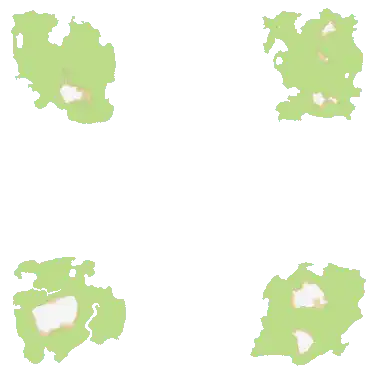
Official OpenFront v0.34 Four Islands thumbnail. Use it for orientation, then count live spawn rings and inspect the actual shoreline before committing.
The map binary confirms four disconnected passable land components. Their sizes are 129,801 in the northwest, 129,035 in the northeast, 129,495 in the southwest, and 129,175 in the southeast. The difference between largest and smallest is 766 tiles, about 0.6 percent of the largest component. No island receives a meaningful opening tier from area alone. Coast length differs more: the same binary scan finds about 2,001 ocean-edge land tiles northwest, 2,348 northeast, 2,634 southwest, and 1,730 southeast. Those values describe available edge geometry, not safe Port sites. A longer coast provides more candidate exits and more places an enemy can land; it is optionality and exposure at the same time.
| Current v0.34.20 fact | Verified value | FFA opening consequence |
|---|---|---|
| Full map | 1,500 × 1,500 | The central water is a real travel and attention cost |
| Playable land | 517,506 tiles | Each island supports a substantial local contest |
| Connected land components | 4 | Every inter-island expansion needs a water solution |
| Component sizes | 129,035–129,801 | Live crowding matters more than static island size |
| FFA rotation weight | Inherits multiplayer weight 4 | Four Islands can appear in ordinary FFA rotation |
| Team rotation weight | 30 | Team advice is common but does not define FFA spawns |
| Forced modifier | isWaterNukes:50 | The playlist gives Water Nukes a 50% roll on this map |
The forced modifier is the fact most likely to invalidate a memorized plan. The tagged playlist parser reads an entry such as isWaterNukes:50 as a 50 percent chance, excludes conflicting modifiers when the roll succeeds, and counts the result against the modifier cap. Read the lobby rather than assuming which branch you received. In a normal-nuke match, an inland core mainly buys travel time and protection from transports. In a Water Nukes match, the same concentrated core can be converted into permanent water by a successful strike, so spacing critical structures and preserving a second coast matter sooner. The Water Nukes guide owns the blast and terrain-conversion mechanics; this guide uses the modifier only to decide how much concentration and crossing risk the opening can tolerate.
The four official Nation anchors sit one per island. A full-resolution terrain scan places them between 52 and 86 passable land steps from ocean. These anchors are useful orientation points, not guaranteed human positions or recommended starts. A player spawning next to a named Nation still has to count humans, trace neutral land, and inspect coast access. Treat the data as a constraint: four separate local contests, almost equal island area, different coast exposure, and a coin-flip branch that can make every dense coastal base more fragile.
The FOUR framework during the spawn countdown
Start with Find. Count human spawn rings on each island before comparing scenery. Then inspect the candidate’s local pocket: neutral or Nation land for early growth, one compact place for a City and reserve, and at least one coast that does not share its tile with the first hostile border. Count competitors who can reach the same pocket without crossing water. A human on another island is strategically relevant later, but a human ten tiles away on your island can end the opening before the first Port finishes. If two candidate islands look similar, choose the one with fewer humans per usable inland route, not the one whose outline appears larger.
Continue with Own. Define what makes the starting island stable enough for a crossing. Use observable conditions: one nearby rival eliminated or contained, the home core outside a one-push collapse, a Port location connected to owned land, and enough current troops to survive the strongest local counter while a transport force is absent. Do not use a timer such as “boat at minute three” as the condition. A quiet island may satisfy the conditions early; a crowded island may never satisfy them. An alliance can contain a rival temporarily, but record its expiry and do not count allied land as your reserve.
Use one named crossing after the home condition passes. The crossing must buy one of three things: a weak rival whose removal changes the board, an underfilled island with room to create a second core, or a coast that opens income and future routes unavailable at home. Crossing merely because the Port is ready is not a reason. Before launch, point to the landing tile and the next land objective. If the landing creates a tiny beach with two defenders and no room to widen, the boat delivers troops into a trap. If the target coast is empty but the island’s interior is already controlled by a strong player, the beach is empty for a reason.
Finish with Read. Read the lobby modifier, the target’s reserve, the movement of local rivals, and the outside beneficiary. A Water Nukes match changes structure spacing and the value of a densely built beach. A target who begins moving troops toward the shore can invalidate the landing while the Transport is still cancellable. A local rival who turns toward your Port can make home more important than the distant objective. A third island leader who benefits while you and the target spend each other can make a tactically winnable crossing strategically bad. FOUR is a loop: after every border change, run Find again on the new island distribution rather than treating the original plan as a promise.
Write a cancellation signal as part of the framework. Examples include “cancel if the target has a larger shore reserve than the landing,” “cancel if our home force falls below the local rival’s visible force,” and “cancel if Water Nukes opens a direct water lane to the core.” A cancellation signal is valuable precisely because it can trigger before sunk cost becomes pride. Transports can be recalled under the conditions described in the recall and cancel guide; a bad strategic commitment cannot be recalled after the home island falls.
The framework also prevents false symmetry. The four islands are similar in total area but not in live state. One may have four humans and untouched Nations, another eight humans already colliding, and another a player rushing its only visible coast. Run FOUR on the match you joined, not on a tier list. The best spawn is the one that leaves a stable core and a choice of crossings after the first local contest, because a choice survives new information while a memorized route does not.
Own or contain the first island without becoming trapped there
The first island is a complete FFA before it is a naval base. Expand into the cheapest neutral or Nation land that improves your shape, keep the core away from a shoreline another player can reach in one landing, and avoid opening several equal human borders. The map gives every island enough land to support a real local economy, so you do not need to gamble the opening on an immediate crossing. What you do need is a route to the sea that remains yours after the local fight. A player who wins interior land but loses every coast has won a temporary pocket; a player who owns a Port but cannot defend the inland core has bought an evacuation point.
Choose the first local target by the result it leaves. Removing a small rival is valuable when it closes a border, gives you a protected coast, or prevents that rival from cutting the core-to-Port corridor. The same removal is poor when it opens a longer border with the island leader or consumes the reserve while two neighbors watch. Before attacking, state the after-map: which borders disappear, which coast becomes usable, and which player can punish the fight. The threat assessment guide supplies the whole-board target scan; on Four Islands, add one question: does this fight preserve or destroy the first safe crossing?
Do not confuse “contain” with passivity. A stable alliance, a narrow border backed by a reserve, or a rival committed on the far side of the island can all contain local pressure long enough to cross. Check the relationship and movement again before launch. If your neighbor has 180,000 troops near the shared border and your proposed Transport removes 90,000 from a 220,000 home force, the home would fall to 130,000 while the neighbor stays ready. The crossing might be profitable overseas and still be wrong because it turns a contained border into the cheapest attack on the island. Either send less, wait for the neighbor to commit elsewhere, or create a shorter home border first.
Economy follows the same order. A Port is justified when it supplies a named trade or transport route and sits behind a defensible coast. A City is justified when capacity is the bottleneck in holding the local island or funding the landing reserve. A Factory is justified when protected stations create a working inland network. None of those structures fixes a bad crowd count. The building timing guide handles the purchase comparison; Four Islands adds the rule that the structure must serve either the home core or the first crossing, and you should be able to name which one before buying it.
Set a local stop line. Stop conquering your island when the next fight would open more borders than it closes, when the opponent can retreat into a stronger third player, or when the time and troops spent would forfeit the cheapest crossing. Stop crossing preparations when the home is not yet stable. These lines pull in opposite directions, and that is deliberate: the correct opening is not “finish the whole island” or “leave immediately,” but the moment when another local capture adds less safety than the first useful overseas foothold.
The opponent’s best counter is to make you believe those conditions have passed. They can retreat from the coast while keeping a reserve inland, show a quiet border and turn toward your Port after launch, or let you take weak land that lengthens your contact with them. Counter with current evidence: visible force, route ownership, alliance timer, and the exact corridor from core to coast. Own or contain the island as a state you can describe, not as a color percentage. That state is the permission slip for the next section’s crossing contract.
Build the first crossing as a contract, not a reflex
A crossing contract has six fields: source coast, target coast, objective, committed force, home reserve, and cancellation signal. Fill all six before launch. The source coast must remain connected to your core and protected long enough for the operation to matter. The target coast must offer a legal landing and a second move after arrival. The objective must be more specific than “expand”: remove a weak island rival, claim an empty core, cut an opponent’s Port corridor, or create a second launch direction. The committed force must beat the force likely to meet it, while the home reserve must still make attacking you expensive. The cancellation signal tells you when a once-correct plan has expired.
Separate scouting from committing. A small probe or visible preparation can reveal whether the target reacts, but a large Transport turns current troops into an absent home force for the duration of the route. Read the target shore again immediately before the irreversible step. The broad central water makes information age while the ship travels: a beach that was empty at launch can have a defender by arrival, and a local rival can move onto your home coast while your attention follows the ship. Set a midway review. If the target has become stronger or home has become cheaper, recall according to the current cancellation rules instead of proving the old screenshot right.
The landing tile is only the first half. Point to a widening route: neutral land, a City corridor, a weak player’s interior, or a defensible edge that can become a second core. A narrow beach under an enemy Warship or beside two hostile borders is a holding pen. Landing there may produce a bright patch of your color without producing another decision. Prefer a slightly longer route to a shore that lets the force spread into durable land. The map’s almost equal island sizes mean the reward is not “reaching the biggest island”; it is reaching the island whose current ownership leaves room to survive.
Keep the home reserve in current troops, not in future hopes. Suppose you hold 240,000 current troops, use a 30 percent send setting, and launch 72,000. The arithmetic leaves 168,000 before any other spending or combat. Compare 168,000 with the strongest local rival and the time it takes them to reach your core. If their visible force is 190,000 beside a broad border, the contract fails even if 72,000 would win the landing. If their force is 110,000 behind a narrow border and committed elsewhere, the same contract may pass. The percentage is not the rule; the post-launch home matchup is.
Gold also belongs in the contract. Record what must remain after the Port, escort, and landing: emergency City capacity, a Defense Post, a Warship repair path, or a nuclear response. A crossing that consumes every liquid option invites the target to delay while another player hits home. Conversely, holding all Gold while a weak opposite shore closes can waste the only cheap expansion window. Tie the spend to the objective and stop paying once the objective is secured. One Port and one successful landing can be enough; additional ships need new jobs.
The defender counters by attacking the route’s dependency. They may threaten the Port, occupy the one widening tile, send a Warship toward the Transport lane, or invite a third player onto your beach. Do not chase every ship. Protect the contract: the source, the landing, and the home reserve. If one counter invalidates two or more fields, cancel. If it changes only the escort requirement and the objective remains valuable, adjust. This turns a dramatic voyage into a bounded investment and prevents Four Islands from converting one ambitious click into two lost cores.
Scenario one: a 40-player FFA with an underfilled northwest island
Assumptions: the lobby has 40 human players, Water Nukes is not active, and the spawn rings are unevenly distributed: eight northwest, eleven northeast, twelve southwest, and nine southeast. Those player counts are illustrative live observations, not fixed map settings. You choose the northwest island because its eight players have two usable inland pockets, while the nine-player southeast island has seven rings crowded around the same coast. Your chosen northwest tile is inland enough to protect a core, can reach a western Port site, and shares early land with one human and one Nation.
Run FOUR. Find says the nominal eight-player count is useful only because the local pocket has one human competitor rather than three. Own means contain that human behind a short border and take the Nation land that connects the core to coast; it does not mean clearing all seven other humans. After the first contest you have 240,000 current troops, a 600,000 cap, one completed Port, and a neighbor with about 110,000 visible troops moving away from you. Across the western water, a northeast player holds a narrow southern beach with 55,000 visible troops, and unclaimed land sits behind it.
The crossing contract is now testable. Source: the protected western Port. Target: the southern beach across the horizontal channel. Objective: take the 55,000 defender’s beach, widen into the unclaimed interior, and establish a second core before the island leader reaches it. Force: a 30 percent send, 72,000 troops. Home reserve: about 168,000, which remains above the local neighbor’s visible 110,000 and sits behind a shorter border. Cancellation signal: recall if the target shore rises above 72,000, if the home neighbor turns back with more than the remaining reserve, or if another northeast player reaches the interior first.
The launch is justified because every field has a reason. It is not justified merely because northwest has the fewest players. During travel, the target reinforces to 80,000. That crosses the first cancellation signal. Do not change the story to “the ship is already halfway there.” Recall while the operation is still bounded. A successful retreat loses 25 percent of the transported troops under v0.34.20, so 72,000 returns about 54,000 before any interception; that controlled loss is still better than feeding the full force into a prepared defense. Wait for one of two new signals: the target spends against somebody else, or the home neighbor becomes a threat that makes crossing irrelevant.
Suppose instead the target falls to 40,000 while fighting north and the interior remains open. Continue, land, and spend only enough to widen beyond the beach. Do not immediately buy a second Transport. First confirm the new shore can hold, the home remains quiet, and the crossing created an independent axis. If the new pocket depends entirely on the original Port surviving, it is an outpost, not yet a core. Build its local reserve or route before treating the second island as secured.
The outside beneficiary check closes the scenario. If a southeast leader is taking the rest of northeast while you fight for one beach, your crossing may feed the strongest player. Set the objective to a bounded slice that blocks that leader or abandon it for a weaker island. The opening succeeds when the underfilled home island gives you enough security to choose the first overseas fight. It fails when “fewest players” becomes a license to stop reading the board. Density selected the start; the live crossing contract decides everything after it.
Scenario two: the Water Nukes roll changes a southeast crossing
Assumptions: Four Islands rolled its configured Water Nukes modifier. The match has reached a four-player late midgame with one leading player on each island. You control most of the southeast island with 400,000 current troops, a compact City-Port-Silo cluster near the northern shore, and 6,000,000 Gold. The northeast rival has 260,000 troops and 5,000,000 Gold, enough for a Hydrogen Bomb under current v0.34 values. The southwest rival is larger but currently fighting northwest. These numbers define the scenario; they are not guaranteed thresholds or a prescribed build order.
The normal-nuke instinct is to use the compact north cluster as a safe launch hub. Water Nukes changes that read because a successful nuclear hit can convert destroyed terrain into permanent water. A dense core near the coast can lose structures and its connection to the island interior in the same event. Read therefore comes before Use. Separate the next critical structure from the existing cluster, preserve an inland path from troops to the Port, and identify a second coast that survives if the northern approach changes. The goal is not to spread randomly; it is to avoid placing every route, weapon, and reserve inside one targetable geometry.
Now test a northeast crossing. At a 35 percent send, 140,000 troops leave and 260,000 remain at home before other losses. The northeast rival can meet the landing with 260,000 and can threaten the concentrated source with a Hydro. The contract fails on both target force and source resilience. Raising the send to 55 percent produces 220,000 abroad but leaves only 180,000 at home, turning the southeast island into the cheaper prize. The right response is not a larger boat. Hold the crossing, move or duplicate the critical dependency, and wait for the northeast rival to commit troops or Gold elsewhere.
The southwest fight creates the alternative. If southwest spends down and exposes an eastern beach, you can cross diagonally toward a weaker target while northeast still expects the direct attack. The route is longer, so information is older at arrival, but it creates a second aim direction and does not feed troops into the 260,000 shore. Use a smaller scouting action, preserve enough Gold for the Water Nukes response, and commit only after the target’s local force is below the planned landing. If the northwest player begins absorbing southwest, cancel again: the landing would create a beach beside the new leader without a stable interior.
The rival’s counterplay is to use nuclear threat without firing. Keeping 5,000,000 visible can pin your structures and make every crossing look dangerous. Do not answer deterrence with permanent paralysis. Reduce the value of one strike, keep two route options, and force the rival to defend more than one coast. Once the northeast force leaves its shore or spends the Gold, rerun the direct contract. A Water Nukes opening does not mean “never concentrate” or “never cross.” It means every concentrated dependency and every landing coast must survive the terrain result of the weapon that can reach it.
The scenario’s success condition is optionality: home remains connected after one plausible strike, the first major Transport attacks a shore it can beat, and at least one other island cannot profit immediately from the fight. Its failure condition is spending 55 percent into a defended beach while the source cluster remains a single nuclear target. The modifier changes the map during play, but the FOUR logic remains stable: find the surviving core, contain home, use a crossing with a contract, and read the new shoreline before the next commitment.
Failure modes and the counters opponents will use
The first failure is ranking the four islands by shape. The official components are nearly equal in area, so an opponent benefits when you ignore live crowding to chase a favorite quadrant. They take the underfilled island while you fight three humans on the “best” coast. Counter by counting competitors per usable pocket and checking the exact core-to-coast route. Coast length is a tie-breaker after safety, not a universal tier list.
The second failure is Port-first thinking. You buy the structure because water dominates the thumbnail, then discover the local rival can take the inland core or the opposite shore has no useful landing. The rival counters by attacking your core while the Port and Transport absorb Gold and attention. Preserve the coast, but purchase only when a named crossing or trade route passes the home-reserve test. A Port is an option generator, not proof that leaving is correct.
The third failure is islandmaxxing without a deadline. You keep improving one safe island while opponents convert three others into territory, income, Silos, and approach angles. They do not need to invade immediately; they can wait until Overtime, Doomsday, or simple scale makes your isolated share irrelevant. Counter with a switch condition: once the local island is contained and a weaker overseas shore exists, the next marginal local purchase must beat the value of a second core. If it does not, cross. The tall versus wide guide provides the broader conversion test.
The fourth failure is crossing to a beach rather than an objective. A defender allows the landing, holds the widening tile, and lets the Transport force sit in a tiny exposed pocket. Counter by naming the second move before launch and cancelling when it closes. A beach is successful only when it reaches land you can hold, removes a threat, or opens a new route. Color on the shore is not completion.
The fifth failure is escort fixation. Your Warship chases an enemy ship away from the lane, leaving the Transport or home Port exposed. The tagged targeting code gives Transport Ships priority over enemy Warships and Trade Ships, and a Warship does not need to reload when attacking a Transport. Treat a visible defending Warship near the route as a hard stop unless you have a specific removal or distraction plan. Assign the escort to a route and an end condition, not to an enemy hull. Protect the crossing until the landing stabilizes, then repair, return, or reassign. Use warship fleet decisions for the ship-count and repair choice.
The sixth failure is ignoring the Water Nukes branch. A dense coast that is acceptable in a normal match becomes a single point of structural and terrain loss. The attacker counters your concentration with one successful blast, then uses the new water to alter approach and retreat lines. Read the modifier before building, separate dependencies rather than every building, and recheck connectivity after each detonation. Do not keep sending toward a coast that no longer leads where the original plan assumed.
| Failure signal | Opponent’s cheapest counter | Your corrective decision |
|---|---|---|
| Favorite island is crowded | Let you spend the local FFA | Move during spawn or choose a quieter pocket |
| Port exists without a target | Attack the inland core | Defer the major crossing and keep reserve |
| Safe island has no deadline | Scale across the other islands | Set a local-to-overseas switch condition |
| Landing has no second move | Hold the widening tile | Cancel or choose another shore |
| Escort chases instead of screens | Hit Transport or source Port | Bind the Warship to the route |
| Water Nukes core is one cluster | Convert structures and terrain together | Separate critical dependencies and rescan |
Every counter attacks a dependency rather than the visible action. The disciplined response is therefore not “add more boats” or “take more island.” It is to identify which field of the contract failed and restore it: home, route, objective, force, reserve, or exit. That diagnosis keeps a recoverable opening from becoming a sunk-cost campaign.
Mode adjustments, sixty-second checklist, and official sources
In public FFA, do not use the manifest’s Team spawn rectangles. Count live rings on the four actual land components and expect diplomacy, opportunistic landings, and an outside beneficiary. A temporary alliance can contain a local rival, but it does not merge your economies or make their coast yours. Record expiry before committing abroad. In No Alliances, require a shorter home border and a larger reserve because the crossing cannot be protected by a temporary local agreement. In a low-player custom FFA, the islands may be underfilled; use the quiet opening to establish independent routes rather than building an oversized single core.
In Team play, stop using this FFA ownership model and move to the Four Islands team coordination guide. Team spawn areas, donations, assigned crossings, and shared victory make “least crowded island” the wrong objective. The terrain measurements still apply, but the owner of the reserve and the beneficiary of a landing are team questions. This separation is why the two pages exist: one answers an individual FFA spawn and crossing; the other answers role assignment across a coordinated team.
Custom ceasefires change timing, not permission. A ceasefire may let a small Transport reach another island before local combat starts, but the route still needs a legal objective and a home plan for the instant protection ends. Community discussion shows why players dispute early ceasefire crossings: the move can create a foothold before defenders are allowed to answer. Treat the lobby rule as a visible contract. If the host allows the action, judge it by the same reserve and landing criteria; if the rules or community agreement forbid it, do not disguise an exploit as an opening framework.
Run a sixty-second audit in four passes. In the first fifteen seconds, count rings by island and discard pockets with multiple humans and one exit. In the second, trace one compact core, one Port-capable coast, and the rival who can reach both. In the third, choose the first local boundary and write the condition that makes the island contained. In the final fifteen, name one overseas target and a cancellation signal. You do not need to build the crossing during the countdown. You need to know what evidence would make it correct later.
Repeat a shorter audit before every major Transport: home can survive the absent force; target is weaker than the landing at arrival, not only now; objective widens beyond the beach; route has a source and escort; reserve includes troops and Gold; modifier has been read; outside player does not gain the match for free. If one item is unknown, scout. If two fail, cancel. If all pass, launch and define when the crossing job ends.
The formal facts in this guide come from the v0.34.20 release, tagged Four Islands manifest, generated map metadata, tagged playlist modifier parser, Transport execution, retreat execution, and Warship targeting. The component and coast counts were reproduced from the official full-resolution map.bin, treating playable non-impassable land with four-direction adjacency. They describe terrain, not win rates.
The handoff is simple. When home is still unstable, stay with local land combat and threat assessment. When the contract passes, use transport landings for execution. When Water Nukes alters the coast, use the dedicated Water Nukes guide before repeating the route. The Four Islands opening is complete when you can name a stable home, a useful second shore, and the event that would make you abandon either one.
Related content
Use OpenFront v34.3 costs, troop growth, route payback, and stop signals to choose City, Port, Factory, defense, or a liquid reserve without copying a fixed script.
- OpenFront AFK Teammate Takeover: Absorb a Disconnected Ally for Zero Troop Loss
A Team-mode decision guide for what a teammate's disconnect does to your win/loss position, when absorbing their land is free, when it is a trap, and what the 30-second mark and the ranked 2v2 rules actually change.
Sep 23, 2026
- Alliance-Break Timing: When 30 Seconds Is Worth the Trade
Decide whether to break a live alliance now, wait for it to expire, or renew it, using the 30-second traitor window, the 0.5 defense and 0.8 speed debuffs, and the -100/-40 relation drops in OpenFront v0.34.
Sep 30, 2026
- OpenFront Annexation and Enclosure: Close Pockets Without Overextending
Learn how to take small footholds, close an enemy pocket, and keep a second route after the capture instead of turning a lead into a fragile border.
Sep 4, 2026