MAPS
Dyslexdria map strategy: spawns, routes, and Compact
Read Dyslexdria's fragmented world, impassable zones, regional wars, long sea routes, and Normal versus Compact decisions in OpenFront v33.7.
Direct answer: how should you play Dyslexdria?
Play Dyslexdria as a network of regional wars, not as one World-map front. Its largest Normal land component holds only 16.77% of playable land. Ten components are needed to reach 85.78%.
First secure a viable region. Then establish a sea route or allied connection that lets the regional economy influence another theatre. Winning locally is valuable, but it does not create a land path to most of the map.
Before spawning, distinguish playable land from the 175,320 impassable land-bit cells. A large visible shape can contain a hard barrier that cannot be owned, attacked, nuked, or crossed by a nuke trajectory.
In Compact, the macro identity survives but many small fragments disappear. Recheck coastlines, landings, and barriers rather than copying a Normal route.
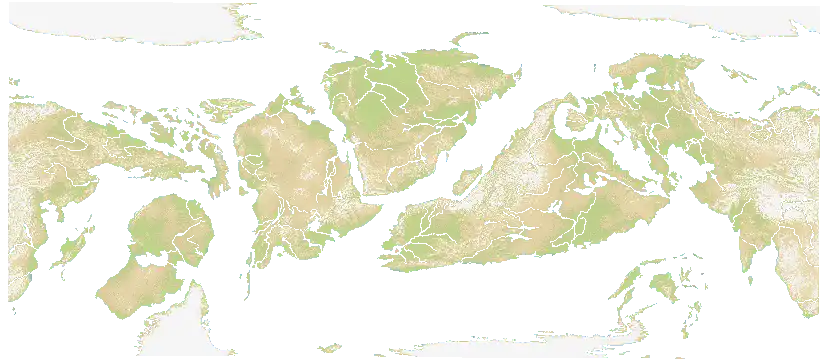
Unmodified Dyslexdria map asset: OpenFront / OpenFront Inc. and Contributors, CC BY-SA 4.0; source in OpenFrontIO v0.33.7.

Dyslexdria facts that change decisions
| Verified metric | Normal | Compact | Practical consequence |
|---|---|---|---|
| Grid | 3,308 x 1,440 | 1,654 x 720 | Very wide in both settings |
| Playable land | 2,103,254 (44.15%) | 508,102 (42.67%) | Compact retains 24.16% of Normal land |
| Land components | 224 | 142 | Many minor fragments disappear or merge |
| Components at least 1,000 tiles | 52 | 24 | Focus on major theatres, not raw island count |
| Largest component | 16.77% of land | 16.78% | No ruling mainland |
| Impassable cells | 175,320 | 43,913 | Hard barriers remain strategically important |
| Shore-adjacent playable land | 4.15% | 7.24% | Compact proportionally exposes more land to water |
| Water components | 1 | 1 | A continuous water route exists across the map |
The official v31 release described Dyslexdria as a returning April Fools map based on a recolored World.
Later v33 releases updated the map, so current decisions must use the v33.7 asset rather than assuming the v31 layout remained unchanged.
The v33.7 manifest has 82 primary Nations. Sixty-nine have fixed coordinates and thirteen do not. Another 189 unpositioned additional Nations form a fallback name pool.
Nation coordinates are NPC anchors, not human spawn points. Ordinary unselected human spawns are sampled from valid free land, and Dyslexdria defines no teamGameSpawnAreas.
Nation count is not human capacity. Ordinary public FFA candidates are 105 / 80 / 55 in Normal and 26 / 20 / 13 in Compact.
Why the ten main regions matter more than 224 components
The raw 224-component count includes many small islands. Only 52 components contain at least 1,000 tiles, and the ten largest already hold 85.78% of playable land.
Use three layers when planning:
- Current component: the land you can reach without transport.
- Regional network: nearby coasts and islands that can support one another.
- Global network: distant theatres connected only by long water routes, diplomacy, or a sequence of staging points.
This prevents two opposite mistakes. One is treating every island as strategically equal. The other is focusing on a single large region and ignoring the economies growing beyond it.
A six-question Dyslexdria spawn check
1. Is this cell truly playable?
Impassable uses the land bit but Magnitude 31. It is a hard blocker, not neutral territory waiting to be captured.
Use actual expansion paths and borders to read it. Thumbnail color alone is not sufficient under every graphic setting.
2. Which land component contains the spawn?
Your component defines the first war. A nearby flag across water belongs to a later route; a farther flag on connected land may be the immediate rival.
3. How much room remains after the first border?
A recognizable region may still be a small share of global land. Estimate whether local growth can fund a later transition.
4. Does impassable create a false exit?
A visible corridor may terminate against a hard barrier. Identify two real land exits before committing to a narrow advance.
5. Which coast reaches a useful second theatre?
All water is connected, but the map is 3,308 tiles wide in Normal. A continuous route can still be too distant or exposed for an early return.
6. Who can contest the destination?
Count local defenders, rival fleets, and players with a shorter coast. The best-looking destination may belong to someone else’s natural route.
Opening route: regional economy, then a bridge outward
Phase 1: finish a coherent local position
Expand along playable land while checking impassable edges. Avoid thin fingers that increase border exposure but stop at blocked terrain.
Your first target is enough connected land to recover troops and support infrastructure. A regional position should survive attention moving elsewhere.
Phase 2: decide whether the region is a base or a trap
A base has land depth, a manageable rival count, and at least one useful coast. A trap is capped by barriers or stronger neighbors and lacks an affordable exit.
If it is a base, consolidate before going global. If it is a trap, preserve troops and choose an exit earlier.
Phase 3: create one bridge to another theatre
A bridge may be a transport landing, a staging island, a friendly coast, or a chain of captured positions. A Transport Ship does not require a Port; it needs your shoreline and a valid reachable target shoreline.
Warships and Trade Ships do depend on an active completed friendly Port. Build one when sustained fleet or trade access changes your options, not as a prerequisite for every landing.
Long routes need a reason: a weak destination, an ally, valuable open land, or denial of a rival’s consolidation. Distance alone does not create strategy.
Scenario 1: you lead one major component
You have the strongest position in your region, but that region is still below one sixth of global playable land.
The failure pattern is to spend the local lead on repeated attacks against small satellites while another player consolidates a second major theatre.
Use this sequence:
- shorten the remaining regional border;
- identify which other major component is becoming dominant;
- select the safest coast with a meaningful destination;
- establish one durable landing or allied route;
- preserve enough force that the original region cannot be stolen cheaply.
An opponent can counter by forcing you to defend both the landing and your home coast. Do not keep reinforcing a bridge that has no path to wider land.
Withdraw attention before a failed expedition consumes the advantage it was meant to use.
Scenario 2: impassable splits the visible route
Your spawn appears to have two directions, but one route terminates at impassable terrain. Several players expand as if the blocked area were empty land.
Do not race toward the barrier. Thicken the real route and use the hard edge to reduce the boundary you must watch.
Then ask whether the barrier also blocks a nuke trajectory. In v33.7, impassable cannot be crossed by nukes. A position behind it may be protected from one angle while still exposed by sea or another land approach.
The counter is to approach around the barrier rather than into it. A rival can use water, another component, or a different firing line. Hard terrain removes routes; it does not make the whole position invulnerable.
Scenario 3: a small coastal region in Compact
Compact Dyslexdria uses 1,654 x 720 terrain, 508,102 playable tiles, 43,913 impassable cells, and 142 land components. Only 24 components remain above 1,000 tiles.
The smaller setting shortens routes, but your familiar minor island or narrow landing may no longer exist. Shore-adjacent playable land rises proportionally from 4.15% to 7.24%, so coast decisions occupy more of the remaining terrain.
Ordinary public FFA candidates become 26 / 20 / 13, and default public Nations fall from 82 to 20. Compact does not simply compress the same population onto a quarter-grid.
Re-evaluate whether the region still has two exits and whether the nearest main component is reachable through the same coast. Treat the Compact terrain as a related map, not a memorized zoom level.
Sea strategy on one connected but enormous network
One water component proves that a continuous path exists among all waters. It does not prove that a ship will take a short route or that a Port will repay its cost.
For each maritime plan, name four things:
- origin: a protected coast in your current economy;
- destination: land that changes regional or global control;
- contest: the player with the shortest response route;
- exit: what you do if the first landing fails.
A staging island is valuable when it shortens reinforcement or opens another coast. It is weak when it only adds a structure and another point to defend.
Because Dyslexdria is extremely wide, information can be as important as reach. Recheck distant regions before launching. A destination that was open during planning may be consolidated by arrival.
Common failures and counters
Mistaking visual land for playable land
The map contains 175,320 impassable cells in Normal. Planning through them creates false exits and false capacity.
Counter by verifying actual ownership and expansion behavior before treating a shape as part of the economy.
Winning a region and stopping the scan
The largest component is only 16.77%. Several remote economies can surpass a regional winner.
Counter by tracking the other major components and creating one route outward before global leaders become unreachable.
Trying to police every island
There are 224 Normal land components, most of them below 1,000 tiles. Spending on all of them disperses force without securing the major land share.
Prioritize the top theatres and satellites that provide a concrete route, refuge, or denial value.
Treating connected water as cheap travel
The water network is continuous across a 3,308-wide map. Routes can still be long, contested, and slow to reinforce.
Counter by using intermediate positions and choosing a destination with enough value to justify the distance.
Reading 82 Nations as 82 players
The manifest’s Nations populate AI identities. Public human capacity comes from playable land and mode rules.
Check the lobby instead of using Nation count as a density forecast.
Copying Normal routes into Compact
Land components fall from 224 to 142 and large components from 52 to 24. Small geography changes substantially.
Rescan the actual coast and impassable edge before committing.
Normal or Compact for Dyslexdria?
Choose Normal for the full fragmented-world problem: 224 land components, long sea transfers, 175,320 impassable cells, and many simultaneous regional wars.
Choose Compact when a smaller lobby wants the same multi-theatre identity with shorter distances and fewer minor fragments. Expect 142 components, 43,913 impassable cells, and 20 default public Nations.
Neither setting produces a fixed contact time or best spawn. The selected player tier, teams, bots, Nations, and spawn distribution still decide pressure.
Use the map size and Compact guide for the exact loading rules. Use the general map strategy guide when comparing Dyslexdria with another topology.
Dyslexdria FAQ
Is Dyslexdria one continent?
No. It has 224 Normal land components, and the largest contains only 16.77% of playable land.
Can ships travel across the whole map?
All water forms one connected component, so a continuous water path exists. Distance, route cost, opposition, and destination still determine whether it is useful.
What does impassable block?
It cannot be owned, attacked, or nuked, and a nuke trajectory cannot cross it. It can reduce borders but may force land, sea, and nuclear routes around the shape.
Are all 82 Nations positioned?
No. Sixty-nine primary Nations have coordinates and thirteen do not. The manifest also contains 189 unpositioned additional Nations.
What changes most in Compact?
Minor fragmentation. Land components fall from 224 to 142, components above 1,000 tiles fall from 52 to 24, and playable land retains 24.16% of the Normal value.
Which map should I compare next?
Use the Svalmel map guide to compare Dyslexdria’s ten-theatre fragmentation with a four-group archipelago.
Primary sources
- Official OpenFront v0.33.7 release
- Dyslexdria manifest in v0.33.7
- Dyslexdria assets in v0.33.7
- v0.31.0 release describing Dyslexdria and inland water
- Terrain loading and Compact selection
- Tile semantics, impassable rules, and map neighbors
- Transport shoreline and water-path validation
- Public playlist and player-capacity logic
- Nation selection logic
Related content
Read Svalmel's four main land groups, choose a defensible spawn, plan sea transfers, and adjust the route for Normal or Compact in OpenFront v33.7.