MAPS
Svalmel map strategy: spawns, island routes, and Compact
Read Svalmel's four main land groups, choose a defensible spawn, plan sea transfers, and adjust the route for Normal or Compact in OpenFront v33.7.
Direct answer: how should you play Svalmel?
Treat Svalmel as four main island theatres connected by one sea, not as 26 equally important islands. In Normal, the four largest land components hold 91.48% of all playable land. The two largest alone hold 66.21%.
Your first decision is therefore local: secure a durable position on one main component before paying to influence another.
Your second decision is maritime: choose a coast that reaches a useful transfer route without turning every shoreline into an obligation.
A good spawn has room to form a compact core, a manageable number of rivals on the same land component, and access to water that matters after the local contest.
A small satellite can be safe, but safety without enough land is a delay rather than an economy.
In Compact, keep the same four-theatre mental model but recheck every minor island and coast. The map uses lower-resolution terrain, loses small fragments, and brings contact closer.
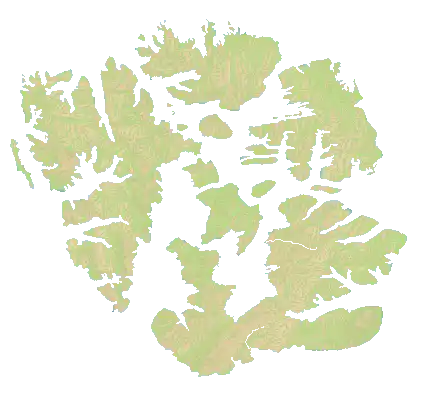
Unmodified Svalmel map asset: OpenFront / OpenFront Inc. and Contributors, CC BY-SA 4.0; source in OpenFrontIO v0.33.7.

Svalmel facts that change decisions
| Verified metric | Normal | Compact | Practical consequence |
|---|---|---|---|
| Grid | 1,700 x 1,580 | 850 x 790 | Width and height halve |
| Playable land | 1,011,623 (37.66%) | 248,032 (36.94%) | Compact retains 24.52% of Normal land |
| Land components | 26 | 24 | Minor islands change, main structure remains |
| Components at least 1,000 tiles | 13 | 9 | Do not plan around every Normal satellite |
| Largest component | 35.28% of land | 35.42% | One large theatre, not one ruling continent |
| Impassable cells | 0 | 0 | Every hard separation comes from water or the map edge |
| Shore-adjacent playable land | 2.80% | 5.46% | Coast exposure rises proportionally in Compact |
| Water components | 1 | 1 | Every main theatre shares one continuous water network |
The official v28 release introduced Svalmel as a Christmas-themed map with five Nations. The v33.7 manifest still lists Santa Claus, Svalbard, Melville, Bathurst, and Nordaustlandet at fixed coordinates.
Those coordinates anchor NPC placement, not human spawns. Ordinary unselected human spawns are sampled from valid free land, and Svalmel defines no teamGameSpawnAreas.
Those five Nations are AI configuration, not five human slots. Ordinary public FFA candidates are 50 / 40 / 25 in Normal and 12 / 10 / 6 in Compact. The selected tier, game mode, bots, and host settings determine the actual lobby.
Read the four main theatres before spawning
Do not start by counting every visible island. First separate the four large groups from the satellites around them.
The largest component holds 35.28% of playable land and the second holds 30.93%. Their similar scale makes both economically important, but the figures do not prove symmetry.
Coast shape, rivals, travel distance, and spawn distribution can make one much harder in a particular lobby.
The remaining two major groups bring the top-four total to 91.48%. Everything outside those four shares only 8.52% of Normal playable land.
That gives satellites three realistic jobs:
- a low-contact opening position with limited long-term capacity;
- a staging coast between larger theatres;
- an escape, distraction, or secondary Nation target.
It does not make every small island worth an early Port. A route must connect your economy to land worth contesting.
A five-question Svalmel spawn check
Ask these questions while spawn markers are still appearing.
1. Am I on a main component or a satellite?
A main component can support a complete land opening. A satellite usually requires an earlier sea transition.
If the thumbnail is ambiguous, use nearby coast and visible land depth. Do not assume two shapes touch because a narrow gap disappears at the current zoom.
2. How many rivals share this exact land component?
Players across water are later threats. Players on the same component compete for the same neutral land immediately.
Count local rivals before comparing the total lobby population. Four distant flags do not create the same opening pressure as two flags on your island.
3. Can I form a compact core before reaching the coast?
An interior core gives troop depth and safe building sites. A thin coastal strip exposes more directions without creating much capacity.
Prefer a route that widens your territory first and reaches a useful coast second.
4. Does this coast open another main theatre?
All Svalmel water is connected, but connected does not mean short. Choose a coast for its destination, not merely because it can host a Port.
5. Where is my stop line?
Set a land boundary before you expand. It may be the point where a second rival appears, where your territory narrows, or where saving for maritime access becomes more valuable than another exposed strip.
Opening route: local control before global reach
Phase 1: establish the island economy
Take neutral land that thickens your position. Watch the rivals on the same component and avoid creating two long fronts simply to touch more coast.
Your first objective is not to own the whole island. It is to hold enough connected land that you can pause, recover troops, and choose between finishing the local contest or moving to sea.
Phase 2: classify the local result
There are three useful states:
- Local lead: you have room and a defensible border. Prepare access to another theatre.
- Local balance: a strong rival shares the component. Keep reserve and deny them an easy finish.
- Local deficit: your land is too small for a prolonged contest. Seek a transfer route before the border closes.
Do not buy a maritime option just because phase two has begun. The destination must improve one of these states.
Phase 3: choose one sea objective
Use the single water network to reach a specific target: unclaimed land, an allied theatre, a weak coastal rival, or a staging island.
A Transport Ship does not require a Port. It needs your shoreline, a valid destination shoreline, and a reachable path through the same water body.
Warships and Trade Ships do depend on an active completed friendly Port. Build one for sustained fleet or trade value, not as an assumed toll for every crossing.
Scenario 1: two strong players share a main island
You and one rival occupy the same large component. Other players are visible across water, but none can attack your land directly yet.
The tempting mistake is to rush a Port and escape the local balance. That spends gold while the rival still competes for your economic base.
The stronger line is:
- widen your core and shorten the shared boundary;
- keep enough troops that a local attack is expensive;
- identify a coast behind the stable part of your territory;
- build sea access only when the destination offers real land or support;
- return attention to the local border whenever the rival’s reserve changes.
The counter is obvious: your rival may expand away from you and take the first useful coast. Do not interpret silence as safety.
If they gain both land depth and uncontested sea access, you need either an earlier denial or a cheaper route to another theatre.
Scenario 2: you spawn on a satellite
The satellite offers few immediate rivals, but it also belongs to the 8.52% outside the four main Normal components.
Do not confuse low contact with a complete position. Your plan needs a mainland destination before the satellite’s capacity becomes the limiting factor.
Use this sequence:
- secure the island without exhausting troops on every edge;
- compare reachable main components by opposition, not visual size alone;
- choose a landing that can widen after arrival;
- retain the satellite as a secondary economy and route anchor;
- abandon a contested landing rather than feeding repeated transports into a prepared coast.
An opponent can counter by watching the obvious route and forcing you to land through a narrow exposed strip. Change destination if the route has become predictable. A connected sea gives alternatives, even when none is free.
Scenario 3: the same group in Compact
Compact Svalmel uses 850 x 790 terrain, 248,032 playable tiles, and 24 land components. Only nine components remain above 1,000 tiles.
The four main groups remain the useful macro model, but the exact coastline and satellites are not a scaled tracing of Normal. Check whether your planned staging island still exists and whether the first local border now forms sooner.
Ordinary public FFA candidates fall from 50 / 40 / 25 to 12 / 10 / 6. Default public Nations fall from five to one. The smaller grid therefore arrives with a smaller default population, not a guaranteed permanent brawl.
Rehearse the opening from scratch. Reusing a Normal click sequence assumes details that Compact deliberately changes.
Common failures and counters
Trying to win all four theatres at once
One water network makes every coast look reachable. Splitting resources across several landings leaves each route easy to contest.
Counter it by naming one primary theatre and one fallback. Expand the plan only after one route produces durable land.
Treating an island win as global control
Even the largest component holds only 35.28% of playable land. A regional lead can coexist with a stronger economy elsewhere.
Track at least the other three main groups. Use the sea to observe and intervene before one rival consolidates a second theatre.
Building a Port on the nearest coast
The nearest coast may point toward a poor destination or a route the enemy already watches.
Counter by choosing destination first, coast second. If two coasts reach the same water network, prefer the one protected by your territory and closest to useful land.
Overvaluing a safe satellite
A satellite can preserve you while the main groups grow beyond you.
Set a transfer deadline based on land and rival development, not a fixed clock. If no landing is affordable, preserve troops and wait for conflict to weaken a coast.
Assuming five Nations means five-player balance
Nations and human slots come from different systems. Public FFA has three capacity candidates, and private settings can differ again.
Read the visible lobby before judging spawn fairness.
Normal or Compact for Svalmel?
Choose Normal when minor islands, longer sea transfers, and several simultaneous local wars are part of the match. It gives the complete 26-component terrain and all five default public Nations.
Choose Compact for a smaller group that still wants the four-island identity. Expect fewer meaningful satellites, shorter map distances, 24 land components, and one default public Nation.
Neither setting guarantees balance or match duration. Spawn distribution, selected population tier, teams, bots, and player decisions remain decisive.
For the exact loading and population rules, use the map size and Compact guide. For the general five-pass method, see how to read any OpenFront map.
Svalmel FAQ
Is Svalmel one archipelago or four maps?
It is one map with one connected water network. Strategically, four major land components hold 91.48% of Normal playable land, so local wars form four main theatres.
Can fleets reach every island?
All water cells form one connected component, so a continuous water path exists. That does not prove every route is short, safe, or profitable.
Does Svalmel have impassable terrain?
No. Both checked terrain levels contain zero impassable cells. Water and map edges create its hard separations.
Is the largest island the best spawn?
Not automatically. It has the most land, but rival count, border shape, coast access, and lobby settings decide whether a particular spawn is strong.
What disappears in Compact?
Some minor land detail changes or disappears. Components fall from 26 to 24 and components of at least 1,000 tiles fall from 13 to 9. The major four-group structure remains recognizable.
Where should I play next?
Compare Svalmel’s concentrated four-theatre structure with the far more fragmented Dyslexdria map guide.
Primary sources
- Official OpenFront v0.33.7 release
- Svalmel manifest in v0.33.7
- Svalmel assets in v0.33.7
- v0.28.0 release introducing Svalmel
- Terrain loading and Compact selection
- Tile semantics and map neighbors
- Transport shoreline and water-path validation
- Public playlist and player-capacity logic
- Nation selection logic
Related content
Read Dyslexdria's fragmented world, impassable zones, regional wars, long sea routes, and Normal versus Compact decisions in OpenFront v33.7.