GUIDES
France Map: Three Separate Coasts, the Water That Connects Them, and the Island You Either Win or Leave Alone
A decision framework for the France map in OpenFront.io. The 2424 by 2424 square, the 34.8 percent land against 65.2 percent water, the Channel, Atlantic and Mediterranean coasts that never touch each other, the offshore Corsica island, and which axis to commit to before the countdown ends so a wrong pick stays recoverable.
What France actually is
Direct answer. France is a square 2424 by 2424 board made of three separate coasts that never meet, sixty-five percent water, and one offshore island, Corsica, that you either win as a second economy or leave alone. Read the coast your spawn lands you on before the countdown ends, hold the anchor nation plus its two neighbours, and treat the sea as the connecting road that decides who can raid whom, not as an empty border to ignore.
France is the map that turns the board into a question of which water you live on. It is a perfect square, two thousand four hundred and twenty-four pixels on every side, with two million forty-seven thousand and ninety-three land tiles under the current manifest. That is the number that defines the map, because two million forty-seven thousand land tiles against the full five million eight hundred and seventy-six thousand and seven hundred and seventy-six tile square means France is only about thirty-five percent land and about sixty-five percent water. Most of the map you will ever look at is ocean, the Channel, the Atlantic, and the Mediterranean, and every named nation sits on one of those three pieces of water or on the land that reaches down to one of them. The real decision on France is not which nation to pick or which building to buy; it is which of the three coasts you commit to before the countdown ends, and how you play the three axes of the board, the Channel coast and its two little islands in the top-left, the Atlantic peninsula in the west, and the Mediterranean arc in the south that carries the offshore island of Corsica, so that a wrong pick stays recoverable instead of fatal. The map is wide enough and watery enough that a mistake on one front is not a mistake on every front the way it is on a narrow peninsula, but it is also the map where ignoring the sea is the mistake that costs the match, because the sea is the road that connects the three coasts. This guide assumes you already know the spawn pacing, the Port and Factory economics, the Defence Post and Warship toolset, and how boats move; it only covers what France’s three-coast shape forces that the generic guides do not.
The version boundary is the v0.35 series, and the current formal release cursor is v0.35.6. France was added in Update 33.0, which predates the v0.35 batch, so its manifest geometry has been stable from 33.0 through the current release; the 2424 by 2424 grid, the 2,047,093 land tiles, the 25-nation list, the flags, and the three-coast layout are the same from the first appearance through v0.35.6. What v0.35 did change that affects France play is the national AI, which now retaliates harder, follows up on beachheads, and targets nuclear strikes more intelligently, and the nuclear territory annexation rule, which lets you seize a piece of territory that a nuke has severed from its owner’s main body. Those are mode-level changes, not map-shape changes, and the mode section below covers them in their own place. Every number in this guide, the 2424 by 2424 grid, the 2,047,093 land tiles, the 25-nation split into 21 mainland nations plus Monaco, Jersey, Guernsey, and Corsica, and the three separated coasts, is read directly from the upstream France manifest at the current release, and the v0.35.6 release is the release against which those numbers are verified. France carries no team spawn rectangles in its manifest, so it is an FFA-oriented board: there is no fixed two-team split line to read, and the whole match is decided by which of the three coasts each player commits to.
The water dominance is the decision
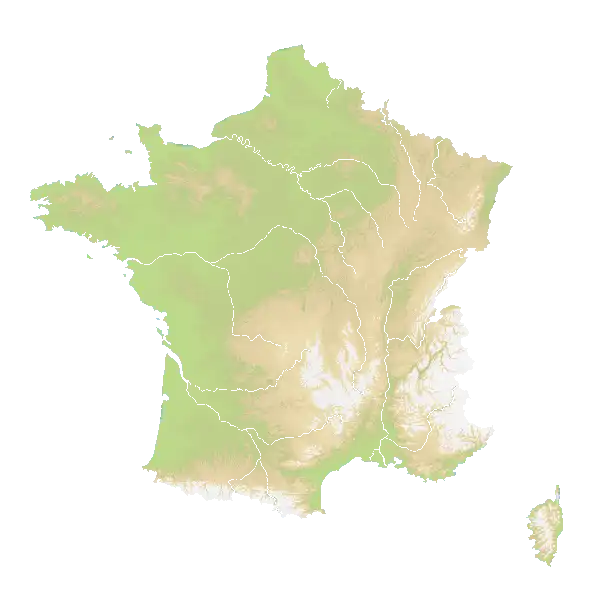
The single most important fact about France is that it is mostly water, and the water dominance is what makes the coast commitment a real decision instead of a coin flip. At two million forty-seven thousand land tiles against a five million eight hundred and seventy-six thousand tile square, France is about sixty-five percent sea, and the sea is not one body; it is three. There is the English Channel in the top-left, with the two Channel islands of Jersey and Guernsey sitting out in it, the Atlantic off the Brittany peninsula in the west, and the Mediterranean arc in the south that curves around the bottom-right corner where Corsica floats. Those three bodies of water never connect to each other on the map, which is the structural fact that defines every match: a player on the Channel coast cannot walk to the Mediterranean, the only road between the two is the open sea, and the player who controls the boats controls the road. That is the whole of France’s geography in one sentence, and the framework below is a way to decide which of the three roads you want to own before the countdown ends.
The water dominance has three consequences that the framework below is built around. The first is that boat access is not a bonus on France the way it is a bonus on a land-heavy map; it is the requirement, because a named nation that does not reach a river or a sea is a named nation that can be fully surrounded and annexed, and on a map where most of the board is water the nations that reach the sea are the ones that survive late. A nation that touches any part of a river, the sea, or the map edge cannot be taken by pure enclosure, so the coastal nations of the Channel, the Atlantic peninsula, and the Mediterranean arc are structurally harder to finish than the inland nations of the centre, and the inland nations are the prize you take for their land rather than the anchor you build on for their water. The second consequence is that the three coasts are separate economies that the sea connects; the Channel coast has the dense northern nations and the two micro-islands, the Atlantic coast has the peninsula and the western nations, and the Mediterranean arc has the southern nations, the Monaco micro-state, and the offshore Corsica, and the player who gets boat access early can raid the second coast before the second coast gets boat access back. The third consequence is that Corsica is the board’s only offshore island, sitting far out in the bottom-right corner away from the mainland, which makes it the one prize on the map that is a separate axis with its own sea route and its own economy, and the one axis where the player who plans the crossing owns a second economy that the other two coasts do not have. The three consequences, the boat-access requirement, the three separate coasts connected by the sea, and the Corsica axis, are the whole of France’s strategic shape, and the framework below is the way to commit to one of the coasts before the countdown ends.
The practical read is to treat the water as a clock the way you would treat the narrowness on a peninsula map. On a wide land map you have room to improvise which direction you grow; on France the room is the water, so the coast you commit to at the countdown is the coast you play for the whole match, and the only safe correction is the one that does not require a crossing of the open sea. That is why the framework names the anchor and the two neighbours before it names the coast, because the anchor is the named nation on that coast that still belongs to you if the coast turns against you, and the two neighbours are the flanks that keep the anchor defensible on both sides. Read the water once, name the anchor, and the coast decides itself.
The nation layer: three coasts, twenty-five nations
The 25 nations on France split into three coasts, and the split is the map. The table below is the full nation layer, read from the upstream France manifest, with each nation’s grid coordinates on the 2424 by 2424 board and the coast it belongs to.
| Coast | Nations | Geography | Economy | First decision |
|---|---|---|---|---|
| Channel (north) | Nord-Pas-de-Calais, Picardy, Haute-Normandie, Basse-Normandie, Île-de-France, Champagne-Ardenne, Lorraine, Alsace, Franche-Comté, Burgundy, Centre-Val de Loire, Jersey, Guernsey | top and top-left, Channel edge | dense northern cities, two Channel islands | anchor a northern coastal city |
| Atlantic (west) | Brittany, Pays de la Loire, Poitou-Charentes, Aquitaine, Limousin, Auvergne | west peninsula and centre-west | peninsula, Port access, Factory spacing | hold the peninsula, then push in |
| Mediterranean (south) | Midi-Pyrénées, Languedoc-Roussillon, Provence-Alpes-Côte d’Azur, Rhône-Alpes, Monaco, Corsica | bottom and bottom-right arc | southern arc, Monaco micro-state, offshore Corsica | win or skip the Corsica crossing |
The thirteen Channel-side nations fill the top and top-left of the board and carry the densest city cluster: Île-de-France is the central-north node at the grid position 1284 by 714, the Paris anchor that every northern expander fights for, with Champagne-Ardenne and Lorraine to the east, Burgundy and Centre-Val de Loire to the south, and the two Channel islands, Jersey at 515 by 606 and Guernsey at 445 by 550, sitting out in the sea off the north-west corner. This is the axis with the most named nations in the smallest area, so it is the axis where two players spawn on top of each other most often and the income ceiling is set by how many of the northern cities you hold by the midgame. The Atlantic-side nations fill the west: Brittany at 471 by 835 is the peninsula that sticks out into the Atlantic, the most exposed and the most defended named nation on the board because it is a peninsula with water on two sides, and Poitou-Charentes, Pays de la Loire, and Aquitaine run down the west coast, with Limousin and Auvergne holding the centre-west inland. The Mediterranean-side nations fill the bottom arc: Languedoc-Roussillon and Provence-Alpes-Côte d’Azur carry the southern coast, Monaco at 1936 by 1788 is the micro-state wedged between the coast and the edge, Rhône-Alpes holds the centre-south inland, and Corsica at 2201 by 2120 is the offshore island in the bottom-right corner that is the map’s separate axis. The Monaco micro-state is a tiny early target that a Mediterranean player takes in the first minute because it is adjacent to Provence and it is too small to hold its own, and Corsica is the one named nation on the board that no other named nation borders, which is why it is the one prize that has to be reached by sea and never by land.
The split matters because it is not even and it is not symmetric. The Channel side has thirteen named nations packed into the top, the Atlantic side has six spread down the west, and the Mediterranean side has six spread down the south, and the three coasts are not the same width of land against the same width of sea. The Channel coast is the densest, so it is the richest and the most contested; the Atlantic peninsula is the most exposed, so it is the most defensible and the most punished when it is wrong; the Mediterranean arc is the longest, so it is the widest and the one that carries the separate Corsica axis. The Monaco micro-state and the two Channel islands are the three sub-one-nation prizes that a coastal player takes in the first minute to get the income and to deny the neighbour, and Corsica is the one prize that is a whole axis of its own. The table is the map, and the rest of the guide is the decision it forces, which is which of the three coasts you commit to before the countdown ends and which of the three sub-prizes, the Channel islands, Monaco, or Corsica, you plan to reach by sea.
Decision framework: name the coast and the anchor before you name the nation
The framework is a sequence of three reads you run before the countdown ends, and the point of the sequence is that the nation is the last thing you decide, not the first. The first read is the coast: which of the three coasts, the Channel, the Atlantic, or the Mediterranean, is the one your spawn lands you on, because the coast is the water you live on and the water you live on is the road that decides who can raid whom. The second read is the anchor: the single named nation on that coast that is the strongest economy and the most defensible position, the northern city with the densest border if you are on the Channel, the peninsula with water on two sides if you are on the Atlantic, or the southern arc with the Monaco micro-state if you are on the Mediterranean. The third read is the two neighbours: the two named nations nearest the anchor, which are the flanks you must keep defensible and the directions you must not send units into until the anchor is safe on both sides. The fourth read, which is the one that France adds on top of the generic framework, is the sea route: the named prize, the Channel islands, Monaco, or Corsica, that is reachable from your anchor by boat and not by land, and whether the crossing is worth the Warship screen and the transport landing.
The rule that the three reads collapse into is the one-sentence France rule: commit to the coast that your anchor sits on, hold the anchor plus the two neighbours, and only reach for the sea prize, the islands, Monaco, or Corsica, after the anchor is defensible on both flanks. The rule works because the anchor is the named nation that is still yours if the coast turns against you, and the two neighbours are the flanks that keep the anchor from being enveloped, and the sea prize is the second economy that only exists if the anchor is safe. If you name the anchor and the coast first and the sea prize follows, a wrong coast is recoverable, because you still hold the anchor and the correction is a flank move across the water, not a crossing of the open sea. If you name the sea prize first and the anchor follows, a wrong coast is fatal, because you have spent the Warship screen on the crossing and the anchor is whatever is left, which is usually the weakest named nation on the board. The framework also tells you when to break the rule, and the two cases where you break it are the two cases where the sea prize is the axis and not a flank. The first is when you are on the Mediterranean and Corsica is unclaimed, because Corsica is the separate offshore island and taking it is a second economy, not a flank that bleeds into the main front. The second is when you are on the Channel and the two Channel islands are unclaimed, because the islands are the dense northern micro-prize and taking them is a second income that does not require a crossing of the open sea. In both cases the rule is the same, commit to the anchor and the two neighbours first, and only when that is safe do you reach for the sea prize. The framework is the tool, and the scenarios below are the two ways the match plays out when you run it.
Scenario one: a mid-sized FFA on the Channel coast
Scenario one is the mid-sized FFA in which you spawn on the Channel coast, and the goal is to show the framework on the densest axis. You are one of the larger lobbies France rolls, call it a sixty-player FFA, because the 2424 by 2424 square with two million forty-seven thousand land tiles puts France on the larger side of the land-driven sizing spectrum and the multiplayer frequency of eight means it is one of the maps that gets queued a lot. You spawn in the north-west, near Basse-Normandie or Haute-Normandie, which puts you on the Channel axis and on the coast with the densest city cluster and the two Channel islands sitting out in the sea to your left. The framework names the anchor as the northern coastal city nearest your spawn, Basse-Normandie or Haute-Normandie, and the two neighbours as Brittany to the west and Picardy to the east. The first decision is the anchor: you take the named coastal city, then you take the two named neighbours, and only then do you reach for Île-de-France, the Paris node at 1284 by 714, which is the first contested prize on the Channel coast because it is the densest named nation and every northern expander is growing toward it.
The numbers in this scenario are the ones that decide it. The Channel axis has thirteen named nations, so a sixty-player FFA on the Channel is a fight for a large share of the northern cities, and the income ceiling is set by how many of them you hold by the midgame. The two Channel islands, Jersey and Guernsey, are the first sea prize, and in this scenario the call is to take them, because you are on the Channel and the islands are the dense micro-income that does not require a crossing of the open sea, only a short boat hop from the north-west coast. The Île-de-France node is the contested prize, and the player who takes it before the neighbour owns the middle of the Channel coast. The assumption is that you are not the strongest player on the Channel, because if you are, the scenario is the same except the Île-de-France node is a bonus instead of a fight, and the anchor and the two neighbours are the same either way. The failure this scenario exists to prevent is the player who commits to the coast and spreads along the whole Channel shore, because on a board this watery that spread is the loss, and the anchor plus the two neighbours plus the two Channel islands is the only shape that keeps the Channel yours while the Atlantic and the Mediterranean are still free to grow.
Scenario two: the Mediterranean arc and the offshore Corsica
Scenario two is the FFA in which you spawn on the Mediterranean coast, and the goal is to show the framework on the axis that carries the offshore island. You spawn in the south, near Languedoc-Roussillon or Provence-Alpes-Côte d’Azur, which puts you on the Mediterranean axis and on the coast that carries the Monaco micro-state and the offshore Corsica island in the bottom-right corner. The framework names the anchor as the southern coastal nation nearest your spawn, Languedoc-Roussillon or Provence, and the two neighbours as Rhône-Alpes to the north and Midi-Pyrénées to the west. The first decision is the anchor: you take the named coastal nation, then you take Monaco in the first minute because it is the micro-state adjacent to Provence that is too small to hold its own, and only then do you reach for the Corsica crossing, which is the separate axis and the second economy of the Mediterranean.
The numbers in this scenario are the ones that decide it. The Mediterranean axis has six named nations plus the Monaco micro-state and the offshore Corsica, so it is the longest and the widest axis on the board, and the income ceiling is set by how much of the southern arc you hold by the midgame plus whether you win Corsica. Corsica sits at 2201 by 2120, far out in the bottom-right corner, and it is the only named nation on the board that no other named nation borders, which means the only way to reach it is by sea and the only way to hold it is with the Warship screen and the transport landing. The crossing to Corsica is a sea route, and the cost is the Warship screen and the transport landing, so the scenario is: anchor the southern coastal nation, take Monaco, hold the two neighbours, and only then send the second economy to Corsica if the anchor is safe on both flanks. The assumption is that the Mediterranean is not your strongest coast in the lobby, because if it is, the scenario is the same except Corsica is a bonus instead of a fight, and the anchor and the two neighbours are the same either way. The failure this scenario exists to prevent is the player who commits to the Mediterranean and reaches for Corsica before the anchor is safe, because on a board this wide that early crossing is the loss, and the anchor plus the two neighbours plus Monaco is the only shape that keeps the Mediterranean yours while the Channel and the Atlantic are still free to grow. Corsica is the one prize on the board where the player who plans the crossing before the countdown ends owns a second economy that the other two coasts do not have, and the player who does not plan it leaves it to the first player who does.
Failure modes and opponent counterplay
The failure modes on France are three, and they are all the same failure with a different name, the failure of committing to a coast before you commit to an anchor and a sea plan. The first is the coast spread, which is the player who picks the Channel because it looks dense and spreads along the whole shore, and the counter is the anchor plus the two neighbours, which is the only shape that keeps the Channel defensible on both flanks while the two Channel islands are still free to take. The reason the coast spread is so common is that the Channel coast looks like the densest coast on the board and the player wants the income, but the income only exists if you still hold the anchor, and spreading along the shore gives the income away to the neighbour while you own the weaker named nations. The second is the Corsica neglect, which is the player on the Mediterranean who treats the offshore island as irrelevant because it is detached and far away, when in fact it is the separate second economy and the first prize of the player who plans the crossing, and the counter is the axis rule, which is to name Corsica as the second economy and plan the crossing before the countdown ends. Corsica is easy to neglect because it is the small part of the board, one named nation against the six of the Mediterranean arc, and the crossing looks expensive, but the second economy is the prize that wins the match when both Mediterranean players hold the mainland. The third is the early crossing, which is the player who holds the anchor and reaches for Corsica or the Channel islands before the two neighbours are safe, and the counter is the two-neighbour rule, which is to keep the two flanks safe before the sea prize is open. The early crossing is the failure that looks most like a win in the lobby, because the player who holds the anchor and the sea prize controls the whole coast, but it is the most fragile shape on a watery board, because the two flanks are the two sides the enemy can hit while you are busy on the crossing.
The opponent counterplay that the three failures feed is the coast grab, which is the player who takes the contested coast before you do. On the Channel the coast grab is the player who takes Île-de-France first, because the Paris node is the densest named nation and the player who owns it owns the middle of the Channel coast. On the Atlantic the coast grab is the player who takes Brittany first, because the peninsula is the most defended named nation on the board and the player who owns it owns the west. On the Mediterranean the coast grab is the player who takes Corsica first, because the offshore island is the separate economy and the player who wins the crossing owns the second axis. The counter to the coast grab is the same framework run one minute earlier, which is to name the anchor, the two neighbours, and the sea prize in the lobby so the coast and the crossing are already on your plan when the countdown ends. The three failures and the three coast grabs are the whole of France’s tactical content, and the player who can run the framework is the player who wins the three coasts.
Mode and map adjustments
The mode you are playing changes the France read in a small number of ways, and the map itself changes the mode reading in a few more. The first mode adjustment is the FFA size, which is the lobby the 2424 by 2424 square with two million forty-seven thousand land tiles rolls. France is on the larger side of the land-driven sizing spectrum, and the multiplayer frequency of eight means it is queued a lot, so the FFA on France is usually larger than the FFA on a water-heavy map and smaller than the FFA on the biggest land-heavy maps. In a larger FFA the three coasts are each covered by more players, so the coast spread failure is more likely and the anchor plus the two neighbours is more important, and the sea prize, the Channel islands, Monaco, or Corsica, is more contested because more players are reaching for it at the same time. In a smaller FFA the coasts are covered by fewer players, so the player who names the sea prize first owns the second economy cleaner, and the Corsica crossing is the one axis where the smaller lobby makes the second economy easier to win.
The second mode adjustment is the v0.35 national AI, which now retaliates harder against the player who pulls ahead, follows up on beachheads, and targets nuclear strikes more intelligently. On France the national AI change means the offshore Corsica is a more contested prize, because the AI on the mainland side follows up on a Corsica landing and the AI on the Corsica side retaliates harder if you pull ahead, so the Corsica axis is the axis where the v0.35 AI is most active. The third mode adjustment is the nuclear territory annexation rule, which lets you seize a piece of territory that a nuke has severed from its owner’s main body. On France the annexation rule means a nuke that severs a Channel coast nation from the rest of the northern cluster makes that nation a separate piece you can annex, which changes how you play the northern border and makes Île-de-France a nuclear target as well as a land prize, because the Paris node is the densest named nation and the one that is worth severing. The fourth mode adjustment is the Doomsday Clock, if it is active. The Doomsday reading on France is the same as on any map, which is that the under-forty-percent side is fighting to survive the wave, but the France reading is that the under side is usually the player without the sea prize, because the player without the sea prize is the player without the second economy. The Doomsday reading is the same as the concentration reading, which is that the side with the sea prize is the side that can keep expanding to the last economy, so the under side has to force the sea-prize side to spend units on the screen. The map adjustment is the same as the mode adjustment, because the water-dominant board is the mode on this map, and the mode changes the reading of the FFA size, the national AI, the annexation rule, and the Doomsday Clock. The player who can read both the mode and the map is the player who plays France correctly, and the three coasts are the ones that decide the match.
What to take into your next match
The single takeaway from France is that the board is mostly water and the decision is the coast, and the coast is decided by the anchor. The map is two thousand four hundred and twenty-four pixels square with two million forty-seven thousand and ninety-three land tiles and twenty-five named nations, and the match is decided by which of the three coasts, the Channel, the Atlantic, or the Mediterranean, you commit to before the countdown ends. The decision framework is the tool, which is to read the coast, name the anchor, name the two neighbours, and plan the sea prize, the Channel islands, Monaco, or Corsica, and the scenarios are the two ways the match plays out, the mid-sized FFA on the Channel coast and the Mediterranean arc with the offshore Corsica. The failure modes are the three ways the match is lost, the coast spread, the Corsica neglect, and the early crossing, and the counterplay is the one way the opponent wins, the coast grab. The mode and map adjustments are the last piece, which is that the mode changes how the FFA size, the national AI, the annexation rule, and the Doomsday Clock read, and the map changes where the three coasts and the three sea prizes are.
For the broader systems this opening feeds into, the map strategy guide covers connected land and water networks on any board, the island defense guide covers how to screen the Corsica crossing and when a disconnected sea route means you should fall back to the mainland, the naval stalemate and blockade guide covers how to hold a crossing when the enemy is trying to deny it, the coastal boat defense guide covers how to defend the coast against a boat raid once you have boat access, the choose your spawn guide covers the generic spawn-density reading that the France framework builds on, the v0.35 nations naval doctrine guide covers how the v0.35 national AI plays the sea, and the tall versus wide guide covers when a safe economy should take more land on a square board. Bring those into the same decision and the France opening stops being a guess about which coast looks central and becomes a plan about which coast, which anchor, which two neighbours, and which sea prize you are committing to before the countdown ends, which is the only time the whole thing is still in your hands. The board is watery enough that a wrong coast is recoverable for a short while, but the open sea makes the correction a crossing, and crossings cost time and a Warship you may not be able to afford if you have already burned your early game on a bad start, which is why the players who win on this map are usually the ones who named the anchor and the two neighbours and committed to the coast the anchor sat on, rather than the ones who picked the familiar coast by instinct and then had to improvise the crossing.
Related content
Use OpenFront v34.3 costs, troop growth, route payback, and stop signals to choose City, Port, Factory, defense, or a liquid reserve without copying a fixed script.
- OpenFront AFK Teammate Takeover: Absorb a Disconnected Ally for Zero Troop Loss
A Team-mode decision guide for what a teammate's disconnect does to your win/loss position, when absorbing their land is free, when it is a trap, and what the 30-second mark and the ranked 2v2 rules actually change.
Sep 23, 2026
- How Nations Aim Their Nukes: Smarter Targeting, No Wasted Blasts
A strategy guide for the upcoming AI Nation nuke targeting change: Nations now compute how much of a blast hits enemy land before firing (atom 25%, hydrogen 40% minimums), they skip a spot where another player's nuke is already landing, and they never nuke a target that would hit friendly land. What changes in your decision, the coverage gate, the anti-double-nuke rule, the failure mode and the mode/map adjustments.
Oct 8, 2026
- Alliance-Break Timing: When 30 Seconds Is Worth the Trade
Decide whether to break a live alliance now, wait for it to expire, or renew it, using the 30-second traitor window, the 0.5 defense and 0.8 speed debuffs, and the -100/-40 relation drops in OpenFront v0.34.
Sep 30, 2026